



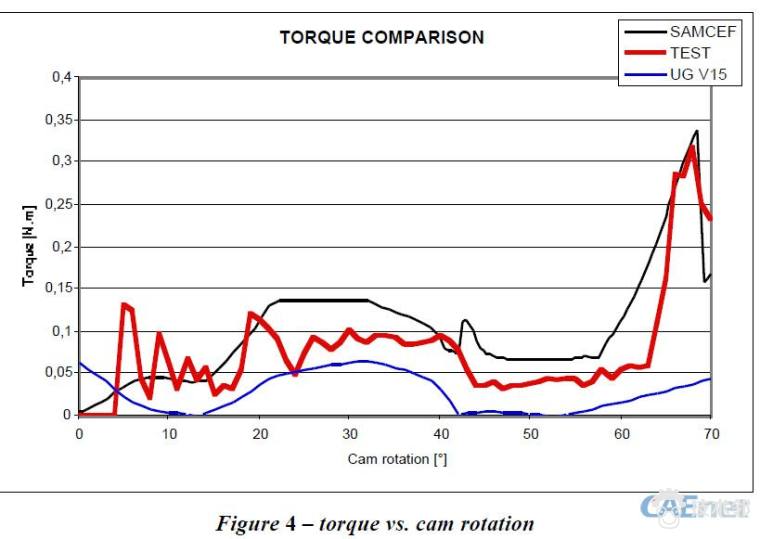
车内空调系统(HVAC system)模块的研发主要在于气流通道的优化及热交换性能的改善。凸轮机构是其中一个重要组成部分,能够达到使气流在乘客区扩散的要求。通常为凸轮机构的预留空间会受到封装的限制,也会考虑到重量,噪音及成本的约束。因此需要在气流输出口的面板上的控制端设计一个突起的旋钮,如图所示。在这个旋钮上施加一定力矩可以控制其状态的切换。这个力矩的大小严重影响着整个系统的质量,为了能够保证在控制端的一个较小而平滑且有效的力矩输出,研究对机械装置的影响,传统的刚体机构建模已经不能满足要求。本案例采取了samtech 有限元柔性体建模方法,为此类问题提供了一种可靠的解决方案,案例的主要组成部分分为:
The main parts ofthe study are:
• Preparation ofthe complete mechanism.
• FEA simulation(kinematics, large displacements / rotations, contact
& friction)with SAMCEF/MECANO “Structure & Motion”
• Correlationbetween bench measurements and theoretical values.
• Optimization of the ventilation track with BOSS-QUATTRO
得到主要结论如下:
The objective of this study was to reduce the number ofprototypes and tests usually needed to develop cam mechanism for HVAC system.The use of finite element method allows to define optimized geometry with nosuccessive tests and prototypes. Thanks to his unique capability in couplingstructural and kinematics analysis, SAMCEF/ MECANO is seen today as a majortool in the new cam design process in place at Delphi Thermal Systems Europe.Indeed, it shows the possibility to predict the torque and stresses generatedin a cam mechanism. It also shows interesting potential for optimization ofsuch a structure.

 技术文档
技术文档
 推荐好文
推荐好文







 155-2731-8020